Family Moving Checklist: Week-by-Week Tasks and How to Split Them
A family move runs from getting mover estimates about six weeks out to updating your driver's license after you arrive. Most of the steps have a deadline, so the easiest way not to miss one is to keep a week-by-week list where the whole family can see it and split the tasks. The list below follows federal moving rules and official state and USPS guidance.
What should you do, and when?
Book the mover four to six weeks out, file your USPS change of address about two weeks out, and update your license and registration once you've arrived.
4–6 weeks out
- Get at least 3 mover estimates
- Check the mover's USDOT number (interstate)
- Give notice to your landlord
- Ask the new school district what enrollment needs
2–3 weeks out
- File USPS change of address
- Schedule utilities and internet: stop and start dates
- Gather school, medical and immunization records
The week before
- Pack room by room
- Eat down the fridge and freezer
- Set aside valuables, cash and documents to carry yourself
Moving day
- Walk through the inventory with the crew
- Read the bill of lading before you sign
- Do a final walk-through of the old home
Delivery day
- Be there, or name someone to stand in
- Note any damage on the inventory before signing
- Photograph the new place before boxes go in
After you arrive
- Update your driver's license and car registration
- Update voter registration
- File any damage claim (9 months for interstate moves)
Sources for each deadline are linked in the sections below. State deadlines vary; we give examples, not a national rule.
Write it down when you think of it. Check it off together.


How do you choose a mover and read the estimate?
Get at least three written estimates based on an in-home or live video survey, and know whether each one is binding or non-binding. For moves across state lines, federal rules (49 CFR Part 375) decide what the mover can charge you on delivery day.
| Binding estimate | Non-binding estimate | |
|---|---|---|
| Price | Guaranteed for the items and services listed | Final price depends on actual weight |
| Cost of the estimate | The mover may charge for it | Must be free |
| What you pay at delivery | The estimated amount | No more than 110% of the estimate; the rest is billed 30 days later |
- Check the mover first: look up its USDOT or MC number in the FMCSA mover search. It covers interstate movers only, and shows registration and complaint history.
- Two booklets you should get: "Ready to Move?" and "Your Rights and Responsibilities When You Move," as copies or links, along with the written estimate.
- The survey can be virtual: a live or recorded video walk-through counts. Skipping it means signing a written waiver before loading.
- Red flags: the FTC warns against movers who ask you to sign blank documents, want cash or a large deposit, or aren't registered with the DOT for an interstate move (FTC, 2024).
- Moving within your state? Federal rules don't apply. Your state consumer protection agency sets the rules for in-state movers.
What happens if something breaks or goes missing?
For interstate moves, file a written claim within nine months of delivery. So if you find a gouge in the dresser a week after unpacking, you still have plenty of time. The mover must acknowledge it within 30 days and pay, deny, or make a firm offer within 120 days (49 CFR Part 1005).
- Full Value Protection is the default: the mover repairs or replaces the item, or pays what it costs to do so.
- Released Value pays far less: if you waive full value in writing, coverage drops to 60 cents per pound per item. A 10-pound stereo worth $1,000 would get you $6.
- List high-value items: anything worth more than $100 per pound has limited coverage unless you list it in writing.
- Before you sign at delivery: write any damage or missing items on the inventory.
- If you can't agree: for claims of $10,000 or less, the mover has to go to arbitration if you ask.
How do you change your address?
Start with USPS, then update the agencies and accounts that mail doesn't reach. You can file anywhere from 90 days before to 30 days after the move (USPS).
- Cost: $1.25 online for identity verification, free on PS Form 3575 at a post office. USPS warns that some third-party sites charge $40 or more for the same thing.
- Timing: forwarding can start within 3 business days, but USPS suggests allowing up to 2 weeks.
- What's forwarded: First-Class Mail for 12 months, magazines for 60 days. A "Family" request covers everyone with the same last name.
- What mail forwarding doesn't change: your driver's license, voter registration, and bank accounts. USA.gov also lists the IRS, Social Security, VA and USCIS.
What do you need to enroll your kids in a new school?
Enrollment is handled by the school district, and most ask for proof of residency, proof of identity or age, and immunization records. In Texas, for example, the district typically asks for a lease or utility bill, an identity record, and immunizations or a valid exemption (Texas Education Agency).
- Records follow the child: under federal privacy law (FERPA), the old school can send records to the new one without your consent (U.S. Department of Education).
- A Social Security number isn't required to enroll in New York public schools (NYSED guidance).
How do you get your security deposit back?
Document the condition of the place when you move in and before you move out, and give the landlord your new address. Deposit rules come from state law, and the return deadline differs by state.
| State | Return deadline after move-out | Worth knowing |
|---|---|---|
| California | 21 days | You can ask for an inspection within 2 weeks before move-out, and be there for it |
| New York | 14 days | You can ask for an inspection before you move out |
| Texas | 30 days | You have to give a forwarding address |
Sources: California Civil Code §1950.5 · New York Attorney General · Texas Attorney General. California's tenant guide recommends walking through the unit with the landlord, filling in a checklist both of you sign, and taking photos of any problems.
When do you update your driver's license and car registration?
It depends on your state, and some deadlines are short. California gives you 10 days to report a new address, and the license and vehicle addresses don't update each other (California DMV). Texas gives you 30 days to update your license, and new residents have 30 days to register a vehicle (TxDMV).
What packing and unpacking tips actually help?
Label the boxes well, keep hardware with the furniture, and record the new place before you fill it. Those three save the most time after the move.
- Label the sides, not just the top: stacked boxes hide their tops. Write the room and contents on a side so the crew can drop each box in the right room.
- Tape the screws to the furniture: put bed and desk hardware in a zip bag and tape it to that piece, so you're not hunting for it at reassembly.
- Photograph the cables: snap the back of the TV, router and game console before unplugging. At the new place, just match the photo.
- Pack a first-night box: toilet paper, towels, a shower curtain, chargers, snacks and the kids' bedtime things in one box marked "open first."
- Photograph the new place empty: walls, floors and fixtures before the boxes come in. It's your move-in record for the deposit later.
- Keep the paperwork on you: the estimate and the bill of lading (the mover's contract and receipt for your belongings) belong in your bag, not on the truck. You'll need them at delivery and for any claim.
- Plan for kids and pets: doors stay open all day while boxes move. Arrange half a day with a sitter or friend so you can watch the inventory.
What will you need to buy for the move?
Split it into packing supplies, cleaning supplies, and things for the first day in the new home. It's easy to remember boxes and forget the shower curtain.
Packing
- Packing tape and a box cutter
- Markers for labels
- Bubble wrap or packing paper
- Zip bags for screws and parts
Cleaning
- Gloves and microfiber cloths
- All-purpose cleaner
- Trash bags
- Vacuum bags or filters
First day
- Toilet paper and paper towels
- Shower curtain and towels
- Snacks and water
- Power strip and light bulbs
For the new place
- Curtains or blinds (measure the windows)
- Doormat
- Storage bins
How do you split the work so nothing slips?
Write things down in one shared place the moment you think of them, and have whoever finishes a task check it off. A move never gets planned in one sitting. On the commute you remember "transfer the internet," and after touring the new place you think "we need curtains." Drop each one in the family group chat and a week later nobody knows who did what, or which curtains you agreed on. Togethery is the shared family shopping and to-do app we make.
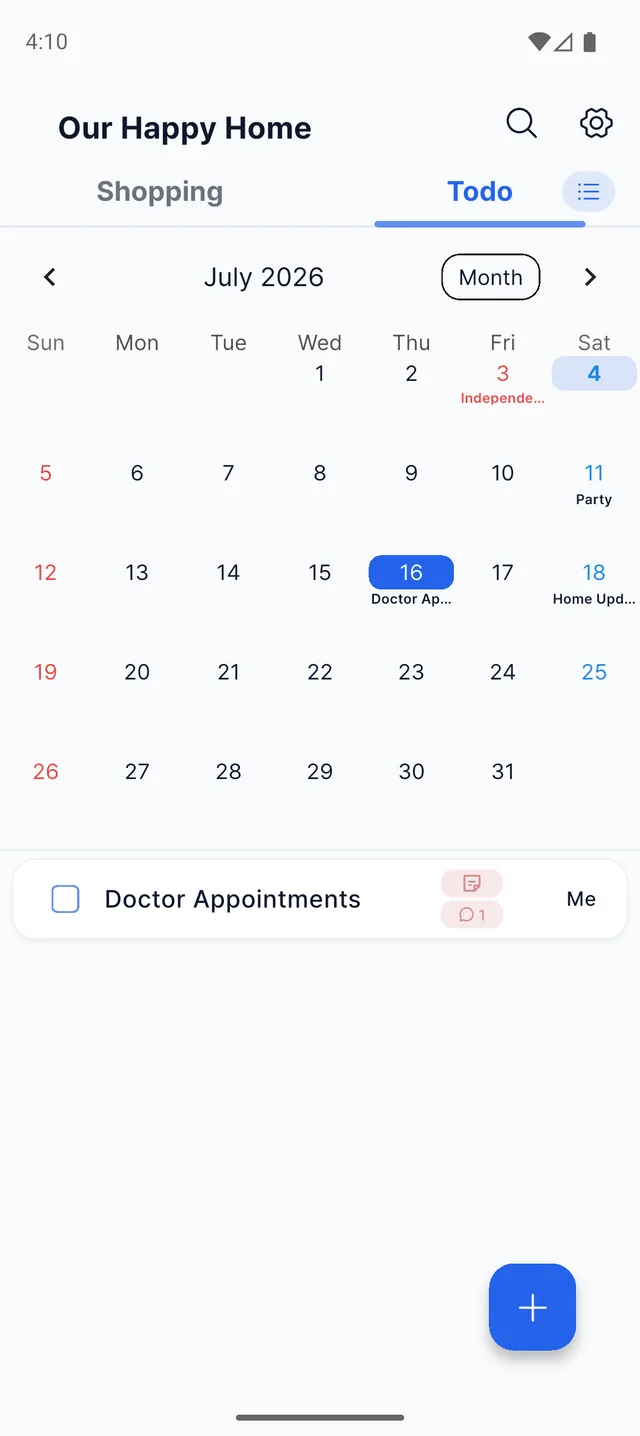
Here's how a family might split a move in Togethery
- Add things as they come to mind, one line each: "Transfer internet service" under Todo, "2 power strips" under Shopping. Whoever adds it, it shows up on everyone's list right away.
- Talk it through on the item. Whoever measured the windows comments "96 inches wide" on "Living room curtains" and pastes a link to the ones they like.
- Whoever finishes checks it off. Everyone else sees "Alex finished" in their activity feed, so nobody has to ask "did you do it?"
- Give tasks with a deadline a date. Set "Schedule utilities" for two weeks before the move and it lands on the calendar, with a reminder to the whole family the day before.
- Keep longer things, like the three mover estimates or the building manager's number, in the Notes tab.
To-dos, things to buy, and the conversations about them all live in one family space, and the list gets shorter as moving day gets closer.
Frequently asked questions
Is there a printable moving checklist?
There is no separate file. The “Print the checklist” button under the week-by-week list prints just the checklist.
How much does a USPS change of address cost?
Filing online costs $1.25 for identity verification. Filing in person at a post office on PS Form 3575 is free. USPS warns that some third-party sites charge $40 or more.
How much do I have to pay at delivery with a non-binding estimate?
For an interstate move, no more than 110% of the non-binding estimate. The mover bills any remaining balance 30 days after delivery.
How long do I have to file a damage claim with an interstate mover?
Nine months from delivery, in writing. The mover must acknowledge the claim within 30 days and resolve it within 120 days.
How soon do I need to update my driver's license after moving?
It depends on the state. California requires you to report a new address within 10 days, and Texas within 30 days.
Start with whatever comes to mind.
Then check it off together, one task at a time.